My research focuses on helping students engage with scientific information in their daily lives. I collaborate with science teachers to develop and study learning experiences that help students evaluate scientific information and data in everyday places, such as on the internet and social media. I have worked on projects investigating how students learn to evaluate science (mis)information on websites and social media posts, how high school science teachers learn to integrate online reasoning strategies into their curriculum, and how students evaluate data visualizations and infographics online. See below for my current research, publications, and selected research presentations. Click here to learn more about some of the work that I’ve done related to science misinformation and education.

Dissertation Research
Learning to Evaluate Scientific Information in the Digital Age
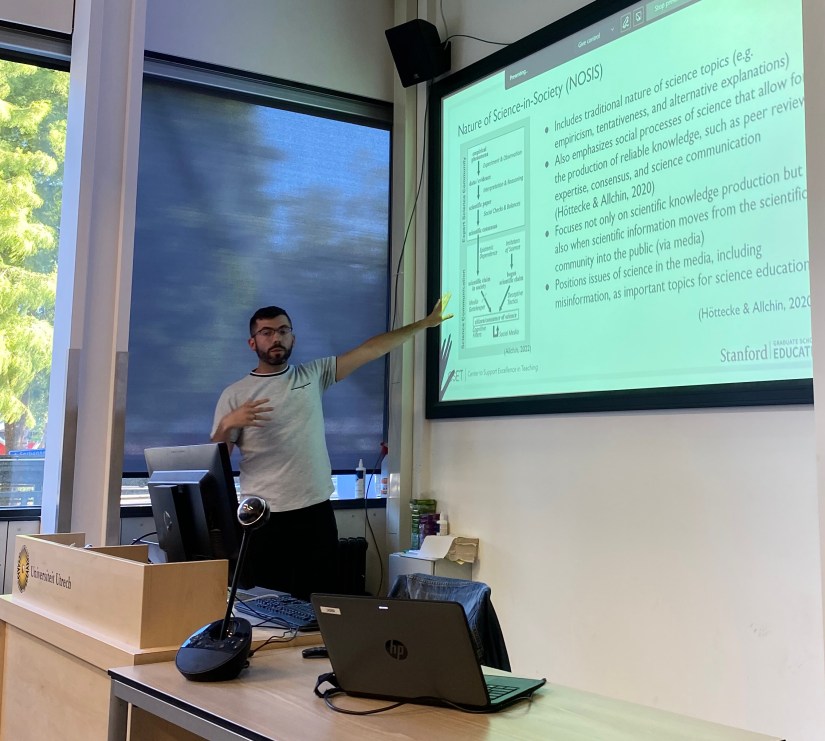
In an increasingly digital world, young people turn to the internet for information about a range of socioscientific issues, like COVID-19 variants and climate change. However, misinformation spreads easily over the internet and students can find it difficult to evaluate false or misleading information online (Breakstone et al., 2021; Vosoughi et al., 2018). Determining the credibility of scientific information poses a particular challenge for students because they need to know if that information has been vetted by social and institutional processes, like peer review by relevant experts, commonly used to produce reliable knowledge in science (Osborne et al., 2022). Drawing on ideas from science media literacy and civic online reasoning frameworks (Höttecke & Allchin, 2020; Wineburg et al., 2022), my current research project examines how high school students learn to evaluate scientific (mis)information on the internet, and how their teacher learns to integrate science media evaluation into his instruction.
In collaboration with a high school biology teacher, I co-designed a series of instructional activities about evaluating scientific information on the internet and implemented these activities in three high school biology classes. Using a mixed methods approach, I examined how students applied ideas from the activities by analyzing pre- and post-assessments, student think-aloud tasks, videos of classroom interactions, and student work samples. Next, I examined what my collaborating teacher learned from the instructional experience using recordings of planning sessions and teacher interviews. Findings from this project will extend current literature focused on science media literacy by providing empirical evidence that suggests teachers and students develop nuanced understandings about evaluating science when science media literacy is incorporated into the science curriculum.
Publications and Research Reports
| Pimentel, D. R., Horton, N. & Wilkerson, M. H. (2022). Tools to support data analysis and data science in K-12 education. Commissioned Paper for the National Academies of Sciences, Engineering, and Medicine, Board on Science Education, Workshop on Foundations of Data Science for Students in Grades K-12. Washington, D.C. [link] |
| Lee, V. R., Pimentel, D. R., Bhargava, R., & D’Ignazio, C. (2022). Taking data feminism to school: A synthesis and review of pre-collegiate data science education projects. British Journal of Educational Technology, 53(5), 1096– 1113. https://doi.org/10.1111/bjet.13251 |
| Osborne, J., Pimentel, D. R., Alberts, B., Allchin, D., Barzilai, S., Bergstrom, C., Coffey, J., Donovan, B., Dorph, R., Kivinen, K., Kozyreva. A., Perkins, K., Perlmutter S., Wineburg, S. (2022). Science education in an age of misinformation. Stanford University, Stanford, CA. [link] |
| Reynante, B. M.*, Selbach-Allen, M. E.*, & Pimentel, D. R.* (2020). Exploring the promises and perils of integrated STEM through disciplinary practices and epistemologies. Science & Education, 1-19. https://doi.org/10.1007/s11191-020-00121-x *Indicates all authors contributed equally. |
| Pea, R., Biernacki, P., Bigman, M, Boles, K., Coelho, R., Docherty, V., Garcia, J., Lin, V., Nguyen, J., Pimentel, D. R., Pozos, R., Reynante, B., Roy, E., Southerton, E., Suzara, M., Vishwanath, A. (in press). Four surveillance technologies and challenges for education. In Niemi, H., Pea, R., & Lu, Y. (2022). (Eds.). AI in Learning: Designing the Future. Springer Nature. |
| Bergstrom C.T., Pimentel, D. R., & Osborne, J. (under revision). To fight misinformation, teach science as a social process. |
| Osborne, J. & Pimentel, D. R. (under revision). Science education in an age of misinformation. |
| Stovall, J.L., Pimentel, D. R., Levine, S., & Carlson, J.C. (under revision). High school mathematics teachers’ noticing of inequitable talk. |
| Wilsey, M., Brown, B., & Pimentel, D. R. (under revision). Assessment for learning: An exploration into how formative assessments can be designed for elementary student science learning and sensemaking. |
Selected Research Presentations*
| Pimentel, D.R., & Osborne, J. (2022, July). Science education in an age of misinformation [Paper presentation]. Paper presented at the biennial meeting of the International History, Philosophy, and Science Teaching Group (IHSPT). |
| Pimentel, D. R., Reigh, E., Lee, V.R., & Brown, B. A. (2022, June). High school students’ conceptions of climate change and COVID-19 data presented in infographics. In J. L. Polman, I. Tabak, & T. C. Tran (Chairs), Cultivating critical, justice-oriented data literacies in a post-truth world [Symposium]. Poster presented at the annual International Conference of the Learning Sciences (ICLS). |
| Pimentel, D.R., Reigh, E., Lee, V.R, Brown, B.A. (2022, April). Data and distrust: Epistemic vigilance and students’ evaluations of infographic trustworthiness [Roundtable presentation]. Roundtable presented at the annual meeting of the American Education Research Association (AERA). |
| Reigh, E., Pimentel, D.R., Lee, V.R, Brown, B.A. (2022, March). Putting on a ‘skeptic hat’: Teachers’ and students’ conceptions of critiquing socioscientific data infographics [Paper presentation]. Paper presented at the annual meeting of NARST. |
| Pimentel, D.R., Moriarty, T.W., & Carlson, J. (2021, April). Supporting science instruction with vertical teams: Teachers’ perceptions of mixed grade-band professional learning communities [Paper presentation]. Paper presented at the annual meeting of NARST. Virtual Conference. |
| Pimentel, D.R., & Stovall, J.L (2021, April). Supporting math and science teachers’ noticing of inequitable participation with video-based instructional coaching groups [Paper presentation]. Paper presented at the annual meeting of the American Education Research Association (AERA). Virtual Conference. |
 Daniel Robert Pimentel